

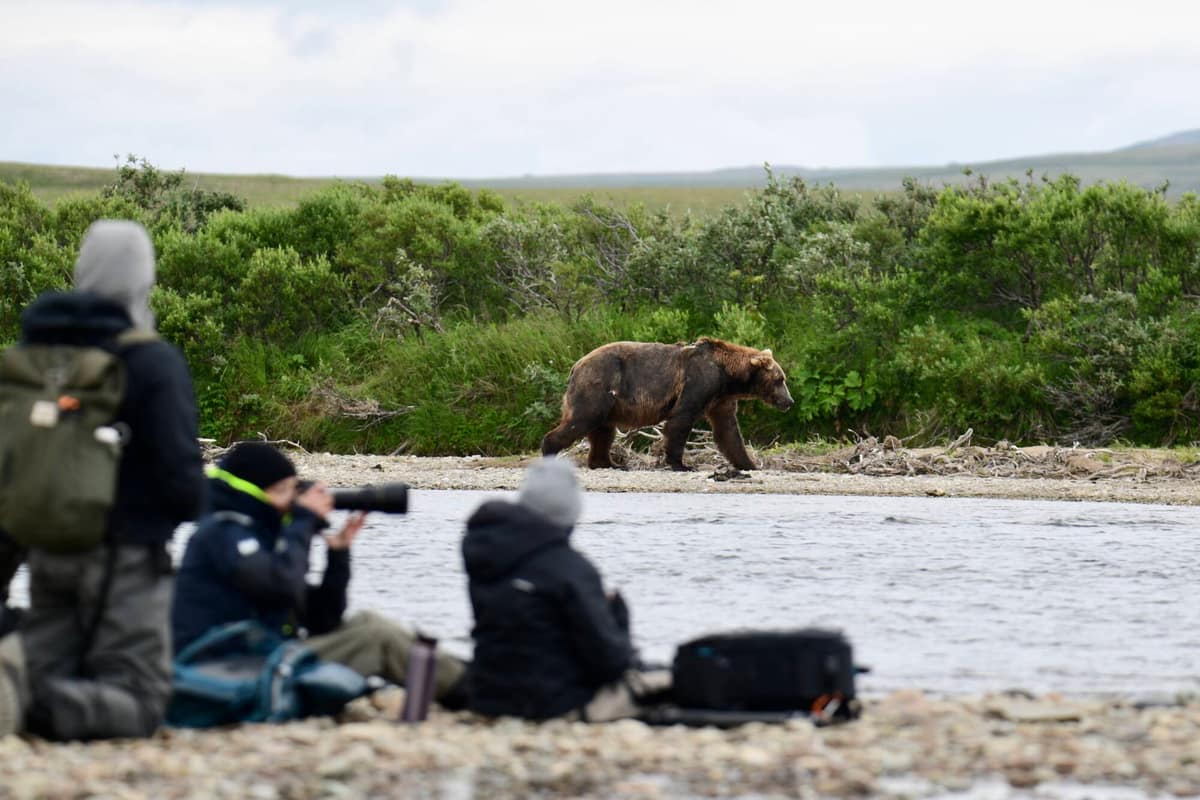
Our passion is bears and providing our clients with the best experience possible.
Helicopters offer an amazing experience of flight. If you have flown in one before then you know exactly what I’m talking about. If you haven’t flown in one then be sure you you get a ride with us. They have huge windows for incredible flight seeing and their ability to hover, fly slower than a walk, land and takeoff with vertical flight is unmatched by other air transportation.
We have combined bear viewing and helicopters to bring you an experience like no other bear viewing adventure. We’ve secured private landing areas that only a helicopter can use while providing an almost an invisible foot print in the wilds of Alaska.
We all know that bear viewing adventures are expensive. Take a trip with us and get the most value for your money. Guaranteed!
The number one Frequently asked question.
No one knows.
That is the best answer I can give. Some of the time I don’t know what the weather will do as close as the night before departure. The main reason, Alaska doesn’t have many weather reporting facilities compared with the lower 48 to help support accurate weather forecasting models.
We stay within the rules, regulations, and best practices. Our pilots have impeccable safety records and we keep safety at the top of the list before each departure.
This is another good question.
We could walk up to 5 or more miles depending on where we go and the location of the bears. We want to land so we don’t displace the bears. With a helicopter we could land very close to them but this is counter productive since the bears would just move away and we would end of walking regardless.
The walking is very slow with lots of rest stops. I’ve taken people in there 90+ and even people that have poor health conditions and they have had no trouble keeping up with the group.
As long as there are no restrictions from your doctor then you will be fine. Our level of intensity is very low. I like to tell my groups that we will walk as fast as the slowest person, and your guide is the slowest person of the group. Walking is less than a couple miles per hour in most cases with plenty of stops along the way to look at flowers and bears. The terrain is mostly flat with some rocks, logs, dirt, mud, and water to walk through and over. If you have trouble balancing or negotiating trail type terrain then I’d suggest bringing a walking stick or two. They sell good ones at REI and any decent outdoor activity support store.
We have had many older visitors some of which are in their 90’s +. Truly amazing individuals. It can be a tiring day for some, especially if they are not accustom to being outside all day. We don’t leave anyone behind and the rest of the group doesn’t notice the slow pace.
There are varied degrees of maturity. If your child or companion can understand and follow direction without difficulty then they are perfect for this trip. Depending on the activity we may be sitting in one place. If your companion has trouble sitting still then it may be a good idea to bring something quiet for entertainment. Examples that I’ve see are books, word games, puzzles and even iPads as long as the sound is turned down to prevent distractions to other guests.
Booking/ Cancelation policy:
Normally a 50% deposit at booking,
Deposit fully refundable up to 30 days before day of trip,
Deposit in non-refundable between 29 days and day of trip,
Full trip price is non-refundable if you cancel within 24 hours before departure time,
Full trip Payment is payable anytime but required no less then 30 days before day of trip,
If we cancel due to weather, passenger has option of a full refund or rebooking on a space available basis,
No bears during tour then a full refund will be given or rebooking on a space available basis.
We supply everything you need for the day; rain gear, hip boots, water proof gloves, binoculars, bug spray, snacks, water.
The only thing you should bring is layers of warm clothes and your camera with its accessories.
This is a great question and asked by just about everyone. My company’s ideals are to observe the bears and nature in its natural habitat and adhere to minimal impact policies and procedures. In short, everyday is different. Some days they can can be so close we can hear them eat. Other days just the opposite, we need binoculars to get a better view.
Most people have a general, healthy respect for something that has the potential to quickly harm our body. Getting close to bears is opposite to most peoples instincts. But at the same time we, as humans, are curious. We want to be a close as possible without getting hurt.
In all of my years of experience I’ve never had an aggressive bear approach any of my trips.
Our guides have been close to bears with visitors like you for many years. Eventually, we learn how to read a bears body language and can understand when they are going to be aggressive well before they are a threat to us.
It seems hard to believe, within a few hours of watching bears unusually the first person in the group that asks to get closer to bears (for a better picture) is the one who was the most nervous before the trip starts.
We will be traveling to the Alaska peninsula by helicopter and landing in private areas. All of the bears we will see are Brown Bears. There are only two other types of bears in Alaska, the Polar Bear and the Black Bear. Other names you may have heard of are is Grizzly and Kodiak Bears. Essentially they are genetically the same as the costal brown bears but they are geographically separated and their main food source is other than fish.
I’ve been guiding and flying bear safaris from Homer, Alaska for the past 17 years and over 10,000 hours of bear observation time.


